
Stop treating politeness as validation.
A lot of marketing problems begin before the marketing even exists. Before the website. Before the launch. Before the content calendar. They begin at the validation stage. Or, more accurately, the fake-validation stage.
So, a founder has an idea. They ask a few people what they think. Three people say: “Wow, that’s sick.”; “I’d definitely use that.”; “Super interesting.”
And suddenly the spreadsheet starts glowing as if God himself approved the business model. Then launch day comes. And there’s no one. Maybe one pity like. Maybe someone comments “love this!” and then vanishes into the same hole where all those “definitely interested” people live.
I see this all the time on founder forums: “People said they liked the product. Nobody bought tho :(” Painful, but very normal. Because “Do you like this?” is one of the weakest validation questions you can ask. Not because people are evil liars. Most people just don’t want to be assholes. They don’t want to look rude. They don’t want to crush your tiny founder soul. They don’t want to say, “I understand the concept, but I feel absolutely no urgency to give you money.”
So they say “cool.” And sometimes they even mean it. Someone can genuinely like your idea and still have zero intention of buying it. Interest costs nothing, commitment does cost something. That’s the difference most early validation completely ignores.
So instead of asking:
“Do you like it?”
“Would you buy this?”
“What do you think?”
Ask something closer to: “How likely are you to buy this in the next 30 days, from 0 to 10?” And define the scale properly.
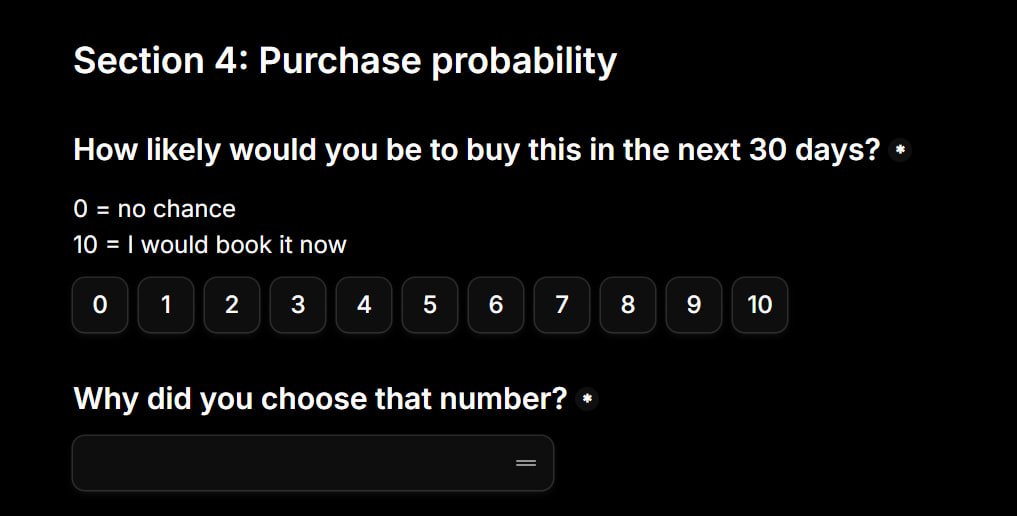
An example of a Validation Survey
0 = no chance
2 = slight possibility
5 = maybe, but not urgent
7 = strong interest, but something is blocking me
10 = I’m ready to act
Is this perfect? No. A 10 is still not a bank transfer.
People are very talented at imagining a better version of themselves. The one who buys the course, uses the app, starts the habit, finally sorts out their marketing, etc.
But a specific intent question gives you a better signal than vague approval. And the real value starts when you combine that answer with context:
What problem do they actually have?
How are they solving it now?
What have they already tried?
What would make this urgent?
What would stop them from buying?
What would they need to believe first?
Now you’re not just collecting compliments. You’re reading signal quality. There’s a big difference between: “Nice idea.” and “I have this problem, I’ve tried solving it, it costs me money or sanity, and I’d consider paying soon if the risk felt low enough.” That difference matters.
Because if you misread early signals, every marketing decision after that gets weird. You write content for people who were only being polite. You build campaigns around weak intent. You polish an offer nobody feels urgency around.
Before you build the funnel, write the ads, launch the content machine, or rebrand because apparently that’s where hope goes to cosplay as strategy… check the signal.
Not all interest is demand. And not all “sounds cool” deserves a business model.
